
Find Baltimore Police Records
Baltimore police records are managed by the Baltimore Police Department, one of the largest law enforcement agencies in Maryland. The city keeps its own set of incident reports, arrest files, crash records, and investigative case documents separate from the county system. You can search for Baltimore police records by filing a request under the Maryland Public Information Act or by looking up court cases through the state judiciary. The BPD has moved much of its request process online, and most records can be obtained by email or through their transparency office.
Baltimore Police Records Overview
Baltimore Police Department Records
The Baltimore Police Department handles all police records for the city. BPD headquarters is at 242 W. 29th Street, Baltimore, MD 21211. You can reach them at (410) 396-2525. Baltimore is an independent city in Maryland, which means it does not fall under any county police agency. The BPD is the sole department that creates and stores police records for the city.
The PIA representative for Baltimore police records is Wayne Brooks. He can be reached at 410-396-2495. You can also email the Document Control Unit at dcu@baltimorepolice.org. All written requests for Baltimore police records should go to the Baltimore Police Department, c/o Office of Legal Affairs, 242 W. 29th Street, Baltimore, MD 21211. The department does not apply standardized fees up front. Instead, they look at each request and tell you what the cost will be before they process it. Do not send payment with your request.
The Baltimore Police Department website is the starting point for all records inquiries in the city.
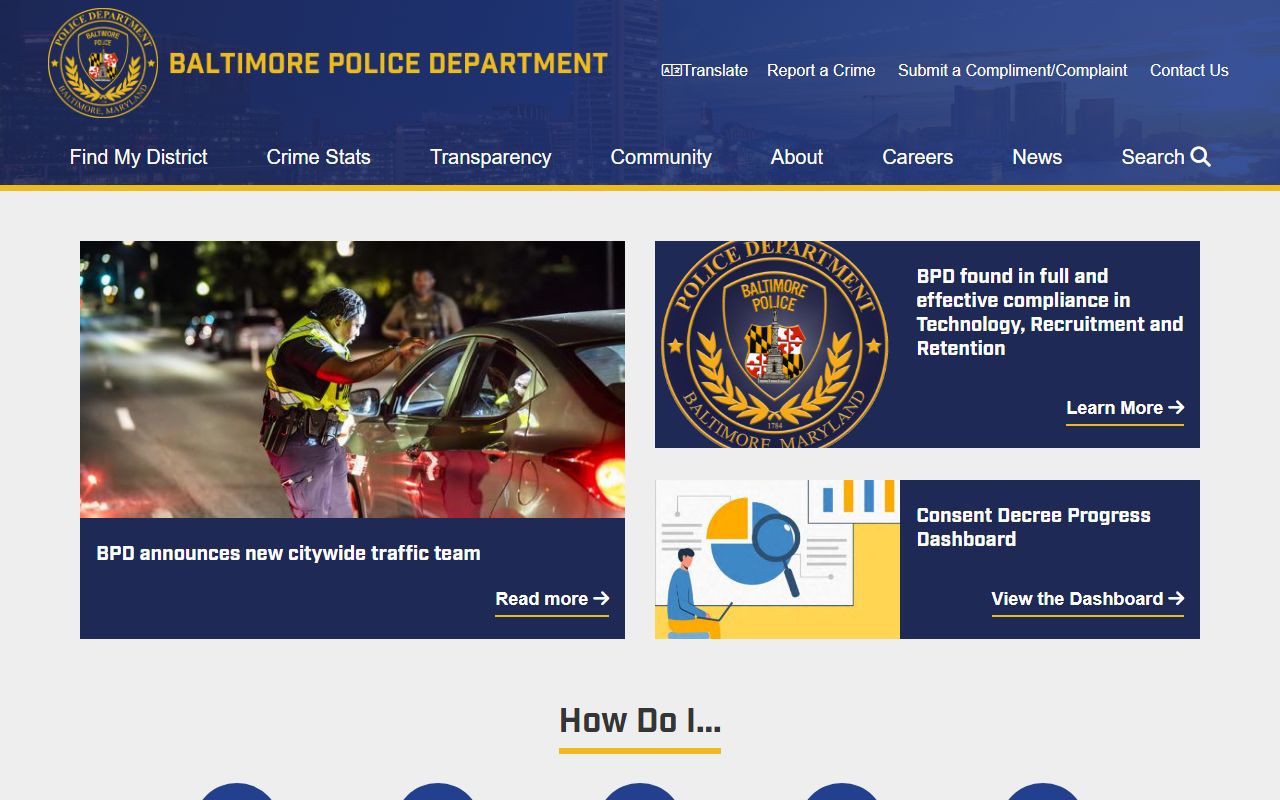
This page gives you access to BPD divisions, contact information, and links to their records request forms.
How to Request Baltimore Police Records
Baltimore police records requests go through the Maryland Public Information Act. Under MPIA §4-201, any person can ask for public records from a government agency. You do not need a reason. The law at §4-203 says the BPD must respond within 10 working days and deliver records within 30 days. Baltimore has its own MPIA request page that walks you through the process step by step.
What makes Baltimore different from most Maryland agencies is the range of specialized forms they offer. The BPD has separate request forms for 911 dispatch audio, body worn camera footage, CCTV footage (Form 381), evidence chain of custody (Form 382), closed investigation case files (Form 383), and CAD data (Form 384). There is also a form for incident scene photos (Form 379) and AIR imagery requests. Using the right form speeds up the process. A general PIA request works too, but the specific forms help staff find what you need faster.
The Baltimore PD MPIA page lists all forms and explains the request process.
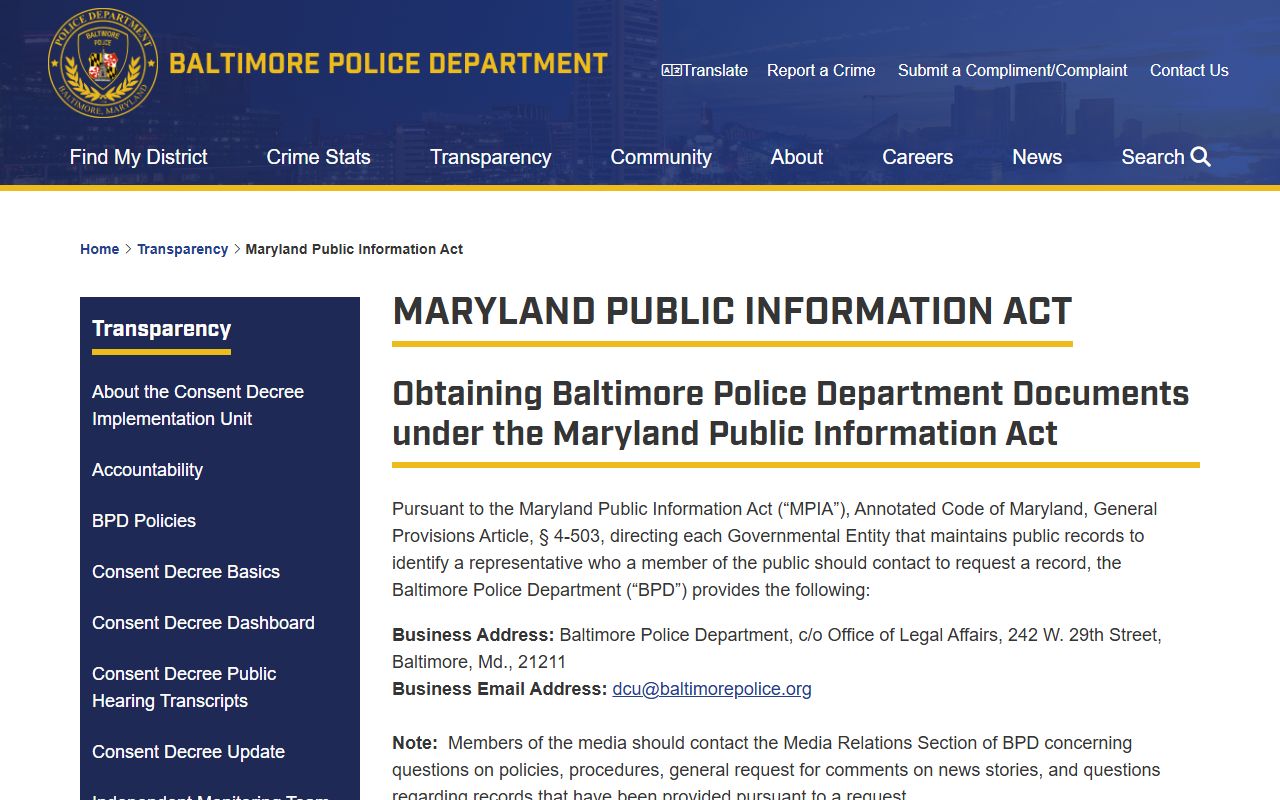
You can download each form from this page and submit your request by mail or email to the BPD Office of Legal Affairs.
Note: Baltimore PD does not charge standard fees up front, so do not send payment until you get a fee estimate from the department.
Types of Baltimore Police Records
The BPD creates and stores a wide range of police records. Incident reports are the most basic type. An officer files one each time they respond to a call in Baltimore. These reports list the date, time, location, and a short summary of what happened. Arrest records show who was taken into custody, the charges filed, and booking details. Both are held at BPD headquarters.
Beyond the basics, Baltimore police records include several specialized categories:
- 911 dispatch audio recordings
- Body worn camera footage
- CCTV footage from city cameras
- CAD (Computer-Aided Dispatch) data
- Closed investigation case files
- Incident scene photographs
- Evidence chain of custody records
Court records tied to Baltimore arrests can be searched for free through the Maryland Judiciary Case Search. This tool covers all Circuit and District Courts in the state. It shows case info but not full document images. Juvenile records and sealed or expunged cases will not appear in the results. For the actual police reports behind a case, you still need to go through BPD directly.
Baltimore Police Records and Accountability
Baltimore has been at the center of police accountability in Maryland for years. The BPD crime statistics page shows data on crimes reported across the city. This data is part of the public record and can be accessed by anyone. The department publishes it as part of its transparency efforts following the federal consent decree.
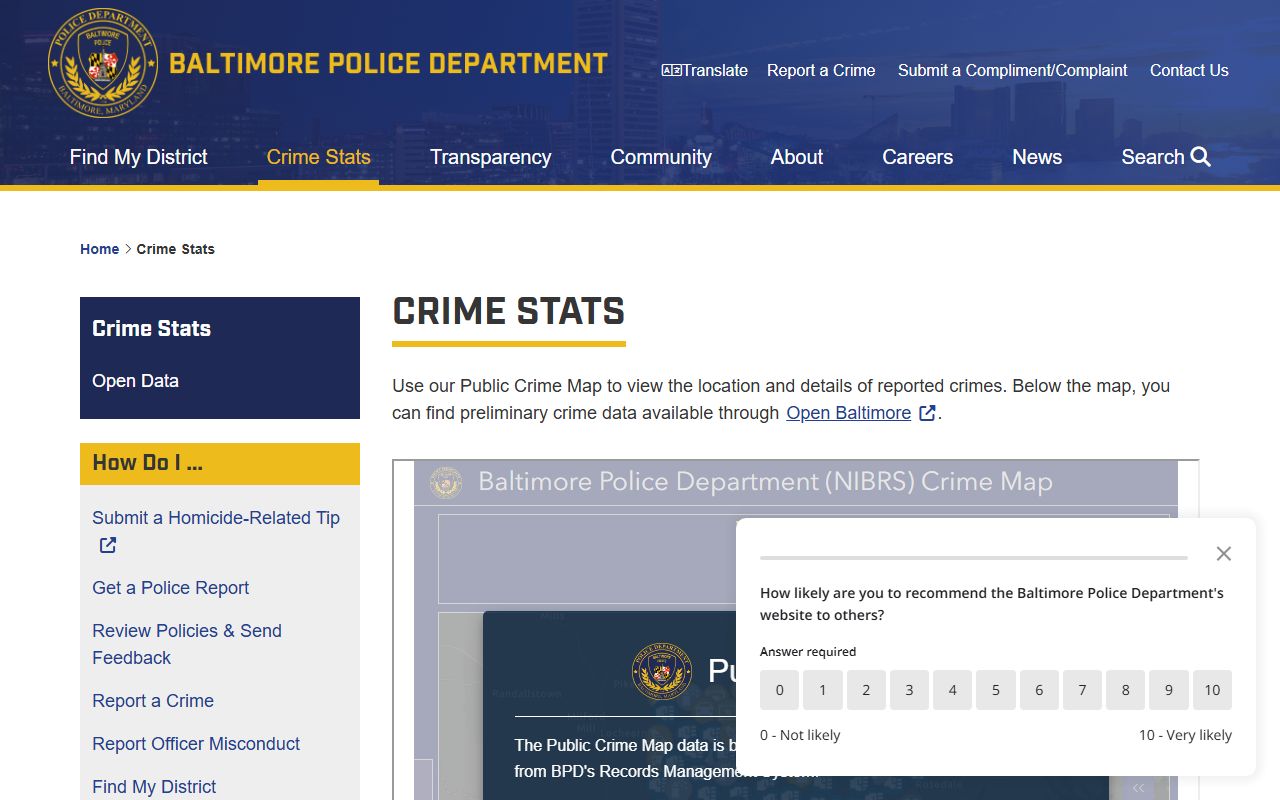
The crime stats page breaks down data by type of crime and area within Baltimore.
Anton's Law changed how police disciplinary records work in Baltimore and across Maryland. Before October 2021, internal affairs files at BPD were locked as personnel records. The Maryland Police Accountability Act at Public Safety Article §3-101 reclassified those records. Now, files tied to misconduct investigations are no longer treated as personnel records. The BPD may release them upon request. This was a major shift for Baltimore, where the consent decree had already pushed the department toward greater openness.
The MPIA at §4-206 sets rules for fees. The first two hours of search time are free at most agencies. After that, the agency can charge based on the hourly rate of the staff member who does the work. Fee waivers are possible under MPIA when a request serves the public interest. The Baltimore Action Legal Team won a case against BPD over fee waivers, which set a precedent for how Baltimore handles these requests going forward.
Note: Baltimore PD operates under a federal consent decree, which may affect how certain police records are handled and released.
Baltimore Police Records Expungement
Maryland law lets people remove certain police records through expungement. The rules are in the Criminal Procedure Article at §10-101 through §10-112. If you were found not guilty in a Baltimore case, had charges dropped, or finished a diversion program, you may qualify. Once a record is expunged, it no longer shows up in searches and BPD must act as if it never existed.
Shielding is a related option under §10-306. It seals certain older misdemeanor convictions from public view. The record still exists, but most people cannot see it. Law enforcement in Baltimore can still access shielded records. Both expungement and shielding affect what appears when someone searches for police records tied to Baltimore cases. The Maryland Judiciary Case Search will not show expunged or shielded cases in its results.
Baltimore Criminal History Checks
The CJIS Central Repository runs fingerprint-based criminal history checks for Baltimore and all of Maryland. Their office is at 6776 Reisterstown Road, Suite 102, Baltimore, MD 21215. The fee is $38 for a state check. Call (410) 764-4501 or email cjis.customerservice@maryland.gov. The Maryland Sex Offender Registry is a free tool that lets you search by name, zip code, or city. Email alerts are available so you can track changes near your address in Baltimore.
Nearby Maryland Cities
Baltimore sits near several other major population centers in Maryland. If you need police records from a nearby area, these city pages may help.